Showing posts with label Joyce Sidman. Show all posts

Friday, September 10, 2010

Book Review: Dark Emperor and Other Poems of the Night by Joyce Sidman

Dark Emperor and Other Poems of the Night
Written by Joyce Sidman
Illustrated by Rick Allen
Houghton Mifflin 2010


Well, Joyce Sidman has done it again! She has written another topnotch collection of nature poems. This time her focus is on the flora and fauna of the woods. This time she examines her subjects through the lens of night. She brings the dark forest to life with her words and imagery. In her poems, Sidman illuminates the nocturnal actions of the snail, primrose moth, great horned owl, orb spider, baby porcupette, cricket, oak tree, mushrooms, eft, tree bat—and provides insight into the moon’s thinking. Dark Emperor is a "must have" book for teachers who enjoy connecting science with poetry/literature--and for kids who are budding naturalists!

Joyce Sidman explains how this book started . . .

I used to be just the teensiest bit afraid of the dark. I loved the concept of the nighttime, its mystery and dark beauty, but the reality was a different story. For us humans—diurnal, sight-oriented creatures that we are—the darkness is alien and forbidding, especially in the woods (which already have dark, mythic undertones). But there are all sorts of creatures that prefer the dark, that thrive in the dark. Why? And how? This book is my exploration of those questions. And you know what? Now that I know so much about these fascinating night creatures, I'm not as afraid of the dark anymore!


Welcome to the Night

Welcome to the Night, the first poem in the collection, is a poem of address. In it, Sidman speaks to woodland creatures and invites them to immerse themselves in their habitat and to use their senses to experience their world after dark:

Come feel the cool and shadowed breeze,
come smell your way among the trees,
come touch rough bark and leathered leaves:
Welcome to the night.


To be sure, Sidman is also welcoming readers to immerse themselves in her poems. She takes readers on a sensory field trip. We experience night in the woods along with the flora and fauna. Sidman even has certain animals, an oak tree, and the moon relate their poetic tales in their own voices.

A young porcupine describes its life after the sun has set:

From I Am a Baby Porcupette

I am a baby porcupette.
I cannot climb up branches yet.
While mom sleeps in the trees I curl
beneath a log till sun has set.

I am a baby porcupette.
I nibble in the nighttime wet:
a sprig of leaves, a tuft of grass,
in hidden spots I won’t forget.


In Cricket Speaks, the winged insect expresses its desire to sing “till the branches tremble/and life/swells/to a single/searing/unstoppable/ sound” when midnight—the trilling hour—arrives.

In Oak after Dark, a tree describes how it carries on its business when most may think it’s merely resting:

As nighttime rustles at my knee,
I stand in silent gravity

and quietly continue chores
of feeding leaves and sealing pores.

While beetles whisper in my bark,
while warblers roost in branches dark,

I stretch my roots into the hill
and slowly, slowly, drink my fill.


In Dark Emperor, a small creature (a mouse) beseeches a great-horned owl to let it be: “O Dark Emperor/of hooked face and/hungry eye: turn that/awful beak away/from me; disregard/the tiny hiccup/of my heart/as I flee.”


Sidman is most adept at incorporating poetic devices and figures of speech and of using language in creative ways in her work. One example: She employs repetition to great effect in a number of her poems. In The Mushrooms Come, she uses it to reinforce how the ubiquitous mushrooms spring from many different places in the forest—moss, loam, crumbling logs, musty leaves—and to help capture a soft and fluid rhythm.


From The Mushrooms Come

Unbuttoning the forest floor,
the mushrooms come,
the mushrooms come.

Like noses pink
in midnight air,
like giants’ ears,
like elfin air,
like ancient cities
built on cliffs,
the mushrooms come,
the mushrooms come.

Each two-page spread in the book contains a poem, an elegantly written informative paragraph about the subject of the poem, and large and small linocuts. The book also includes a glossary that explains such terms as echolocation, stridulation, and omnivorous.

About the Art: Rick Allen uses muted colors and abundant black lines in his illustrations to capture the forest after dark. His pictures draw readers into the woods…into the night…and into the nocturnal goings-on of animals and plants.

(Note: I think kids would really enjoy examining Allen’s illustrations to find all the animals he's included in them that are not clearly visible at a glance.)

Rick Allen informed me that he “never tired of her [Sidman’s] words over the eighteen months or so that we worked on the book.” That’s evident. Allen’s illustrations are perfect companions for Sidman’s words. Both poetry and art enlighten and shed light on a dark world that most of us are unfamiliar with.


**********

I asked Joyce if she come tell me more about Dark Emperor. Here’s what she wrote:

Dark Emperor is part of an original "trilogy" of books I wanted to write, about different ecosystems. Water Boatman was the first (pond), Butterfly Eyes was the second (meadow), and this is the third (woods). I can't really remember when I decided to set it in the night time. It was fascinating to learn how different organisms cope with, and thrive in, darkness. As always, I learned a lot as I researched and wrote the book. One other tidbit: "Ballad of the Wandering Eft" was written to the tune of "Dark as a Dungeon" by Merle Travis. I'm hoping at some point some kid will perform it on You Tube and I can listen!

Good news for Joyce Sidman fans: Joyce and Beth Krommes are working on a picture book for younger children called Swirl by Swirl: Spirals in Nature, that will come out in fall of 2011!

Note: I would like to thank Joyce Sidman for providing me with information about Dark Emperor and for the news about her next book. I also want to thank Rick Allen for his quick response to my request for images of illustrations from the book.

**********

Dark Emperor Book Trailer


Dark Emperor Reader’s Guide
**********

At Blue Rose Girls, I have a poem by Wislawa Szymborska titled Photograph from September 11.
Anastasia Suen has the Poetry Friday Roundup at Picture Book of the Day.

Tuesday, April 27, 2010

UBIQUITOUS by Joyce Sidman & Beckie Prange: A Poetry Book Review


Poetry and science are two of my passions. When I was an elementary teacher, I loved connecting poetry with the different science units I taught. I was always looking for poems to integrate with my units on trees and soils, astronomy, animals, and the life cycle of butterflies. I suppose that’s one of the reasons why Joyce Sidman is one of my favorite children’s poets. She is able to weave her knowledge of nature and science seamlessly into her extraordinary poetry.
I was thrilled when I heard that Joyce was publishing a collection entitled Ubiquitous: Celebrating Nature’s Survivors this year—especially after I watched the trailer for the book.


Ubiquitous: Celebrating Nature’s Survivors
Written by Joyce Sidman
Illustrated by
Beckie Prange
Houghton Mifflin, 2010


Joyce Sidman explains how her book Ubiquitous started at her Web site:

My sister is a biologist who works with insects. One day, on an impromptu nature walk, she snagged a beetle, held it in her hand, and remarked about how successful beetles are--how many species there are in the world. She went on to explain that they had mutated from flies; their forewings had become hardened and armored, allowing them to survive better than flies under extreme conditions. This discussion started me thinking about what allows one group of organisms to stick it out here on earth, while others become extinct. Boy, was it ever interesting to find out! I did more research for this book than any other; but I learned more, too--I basically ended up studying evolutionary history.


I emailed Joyce to ask if she could give me further information about the book. I wrote: “I also saw in your book's acknowledgments all the different scientists you thanked. I was wondering if you'd care to provide me with any other information about the time it took you to complete this book and/or how much research you had to do in evolutionary history.”

Joyce responded: This book took a long, long time to write, because I really had to feel my way. I am not a scientist, and the further I dug into research, the more science seemed to be involved. I started thinking about the idea about eight years ago. I thought it would be fun to find lots of "survivor" organisms to write about, and eagerly listed a whole bunch of them to explore. Then, as I delved deeper into research, I realized that organisms survive for all different kinds of reasons, some of them having to do with disruption by man. In fact, because I didn't want this to be a book about "urban" animals, I deleted poems I'd written about Canada Geese, kudzu (an invasive vine), and pigeons. I wanted to choose organisms that had developed survival mechanisms long before humans showed up. So I went slowly, making sure I was following the right paths, checking in with my biologist sister every once in a while for her comments. Sometimes I put away the book and worked on other things.

Then I decided to group my chosen organisms according to evolutionary history, and that opened another can of worms. My brain was sorely strained by trying to keep all my epochs straight! I bought a big chart called "A Correlated History of Earth" and hung it on my wall.

Beckie went through similar efforts to achieve dynamic yet accurate illustrations. We went back and forth on many facts, and she spent a tremendous amount of time on the timeline. She also caught some math errors of mine (thank goodness!) when I was translating inches into centimeters in the nonfiction notes. I am thrilled with her vividly beautiful artwork, which is similar to, and yet so different from, Song of the Water Boatman. The book is everything I'd hoped it would be.


The book is also everything I hoped it would be. And more!


Although the Ubiquitous may seem a slim collection with just fourteen poems—it is a substantial book. It takes readers from BACTERIA, the first form of life that appeared on our planet over three billion years ago to HUMANS—who appeared very late in earth’s history. In between the poems about bacteria and Homo sapiens, readers will find poems and paragraphs of factual information about the following plants and animals:
Mollusks
Lichens
Sharks
Beetles
Diatoms
Geckos
Ants
Grasses
Squirrels
Crows
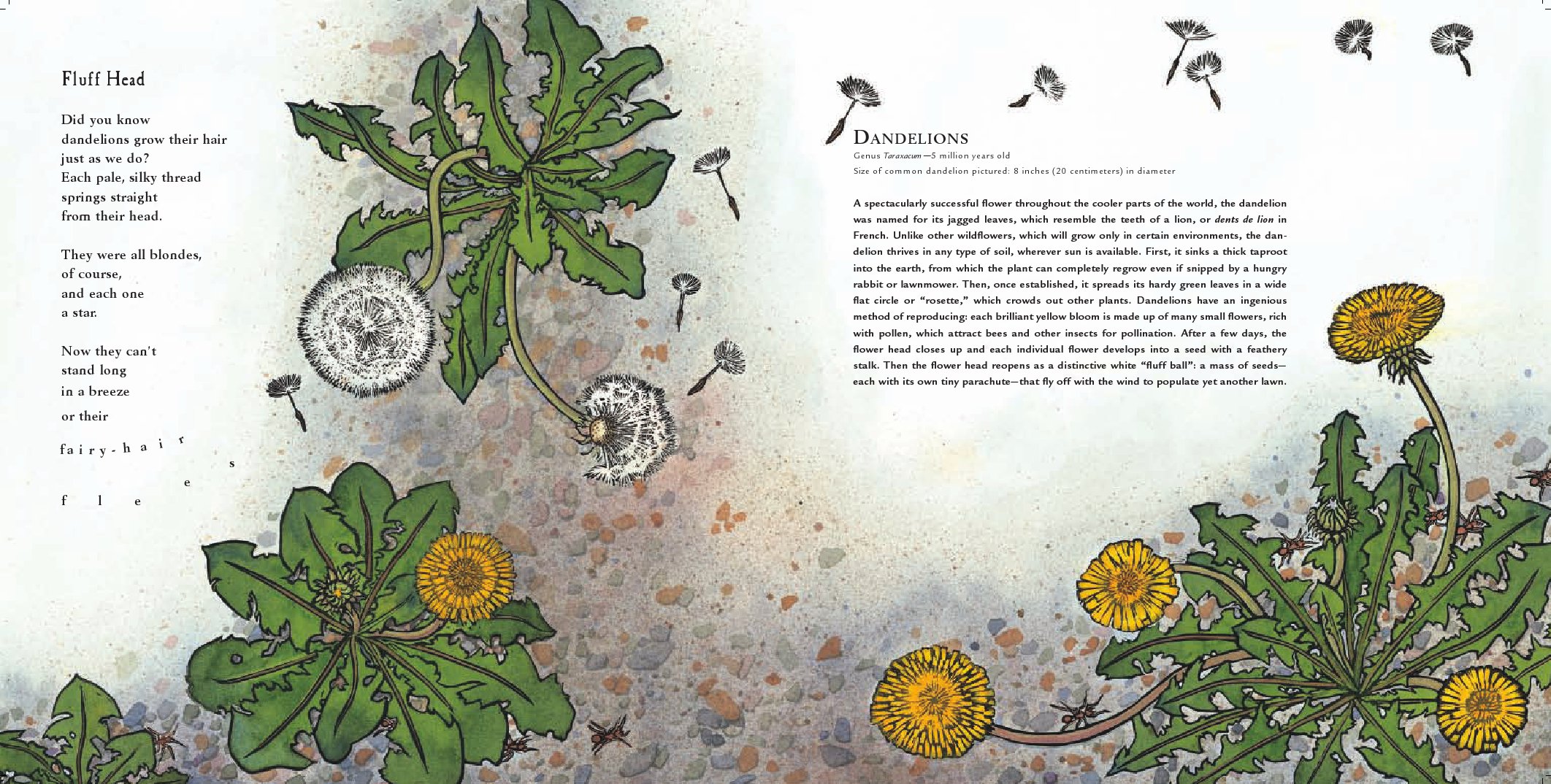
Dandelions
Coyotes


Joyce Sidman has a talent for selecting the best type of poem to express her ideas about a particular subject—be it a pantoum, a diamante, a mask poem, a poem of address, or a shape poem. To my delight, five of the poems in Ubiquitous are mask poems—which I love. Lichens, a scarab beetle, grass, squirrels, and coyotes all speak to us in their own voices. Coyotes extend an invitation to readers. Their three-stanza poem ends with the following four lines:

Come, come with us!
Come kindle the blue twilight.
Come croon in the wild chorus,
come vanquish the tranquil night.


Grass explains that it can grow “in places/others can’t/where wind is high/and water scant…on steppe or veld/or pampas dry.”

In Tail Tale, squirrels speak breathlessly about themselves and their lives. (There’s little punctuation in the poem.) Sidman’s squirrels explain what they like about being who they are. Just imagine if you too had a “free fur coat/and the ability to crack any/safe known to man.”
I doubt there are many poets who would attempt to write a poem told from the point of view of the lowly lichen. Well, Joyce did—and the poem is a gem!

The Lichen We
(after Siegfried Sassoon’s “Man and Dog”)

Who’s this—alone with stone and sea?
It’s just the lowly Lichen We:
the alga I, the fungus me;
together blooming quietly.

What do we share—we two together?
A brave indifference to the weather.
A slow but steady growing pace.
Resemblance to both mud and lace.

As we are now, so we shall be
(if air is clear and water free):
the proud but lowly Lichen We
cemented for eternity.


A detail from Prange's illustration of lichens:

Sidman also includes two excellent poems of address in Ubiquitous. She speaks to a shell in The Mollusk That Made You. The poem begins:

Shell of the sunrise,
sunrise shell.
yours is the pink lip
of a pearled world.

Who swirled your whorls and ridges?


She also interrogates a crow:

What secret orders were you given?
What deeds to do? What plots to thicken?

There are questions in some of the other poems, too, that give readers pause for thought.


Sidman’s poetry about the beginnings of life on Earth…about plants and animals that are survivors who exist here today...both enlightens and engages the reader. It speaks to the wonder of it all. Her prose paragraphs are clearly and concisely written—and contain lots of interesting information.

Beckie Prange’s exceptional hand-colored linocuts serve as the perfect backdrop for Sidman’s poems. They aren’t merely there as decoration. They are an integral part of the book—complementing, supporting, and expanding upon scientific information included in the text. Prange depicts lichens at seven times their life size, provides a close-up look of tiny diatoms as they might appear under a microscope, and illustrates the different stages in the life cycle of beetles. She also gives us a cutaway view of an underground ant colony. This collection is definitely a wonderful marriage of poetry and art…and science!

Ubiquitous gives readers an eloquently condensed and illuminating history of life on planet Earth. I give it my highest recommendation!!!!!

Click here to view a two-page spread about the dandelion from the book.

Click here to read It’s a Long Story: Joyce Sidman’s Ubiquitous celebrates evolution’s winners (article by Rick Margolis—School Library Journal, 4/1/2010)


Beckie Prange Ubiquitous Prints
Giclee prints of Beckie Prange’s illustrations in Ubiquitous are available for purchase at her site. Click here to see them.


Learn More about Joyce Sidman

  • Cybils Interview with Joyce Sidman (Interview by Kelly Fineman, 2/20/2007)
  • Click here to read Jules’s recent interview with Joyce Sidman at Seven Impossible Things.
  • Click here to read all my Wild Rose Reader posts about Joyce Sidman and her poetry books.

Friday, April 17, 2009

Red Sings from Treetops: A Book Review & An Invitation

Red Sings from Treetops: A Year in Colors
Written by Joyce Sidman
Illustrated by Pamela Zagarenski
Houghton Mifflin, 2009
A Little Background about How the Book Started
Here’s an excerpt from the interview I did with Joyce Sidman last year.

Elaine: You told me before that your most recent book, This Is Just to Say, came out of your work as a writer-in-residence—that it came pouring out of you in a way that other books haven’t. How long does it usually take for you to write a collection of poems? What is the process like?

Joyce: Well, it’s different for every book, but generally I start with an idea, or an image, or an emotion. I have a book coming out next year called Red Sings from Treetops—it’s about color in nature. This book started with the deep thrill that color gives me: a flaming red maple or the soft green of new buds. But an emotion or image is not enough—I have to figure out a “voice” for the book: a way to write it so that it captures that original emotion. I played around with all sorts of color poems, touching on this idea or that, and then retreating when it didn’t feel right. This happened over the course of a year. Finally one spring I looked down at some tracks in the mud, and a line came into my head: “Look down—brown. Deer were here, and a dainty raccoon.” That line isn’t even in the book anymore, but I knew that I’d found a way in, a way of talking about color as though it were alive. After that, the book took about three months to write and another few months of tinkering. I have to go slowly. If I force it, it’s just bad poetry. And I have to give it time to rest so I can look at it with fresh eyes and see if it still works.

From Joyce Sidman’s website: Color has always had the power to lift my spirits and thrill me. The first time I saw a cardinal on top of a tall tree, singing his heart out in the late winter sun, I thought, "WOW!" On my daily walks, I started looking for color everywhere, in each season. And it WAS everywhere--even in winter. To me, each color seemed like an old friend come alive somehow. This book is my attempt to bring color to life for others, as well.


About the Book
Those of us who know and love Joyce Sidman’s poetry books appreciate all the "tinkering" she does with her poems and all the time she gives them to rest so she can revisit them with “fresh eyes.” Sidman’s poetry for children is exceptional.

I’m happy to say that her newest book is no exception to the “exceptional” standard she set for herself in creating outstanding collections of poetry in the past. In Red Sings from Treetops, she gives readers insight into colors through her novel approach to writing about them. Sidman takes a seasonal look at BLUE and YELLOW and RED and GREEN and other colors—and shows us what they embody during different times of the year. For example, here’s what she writes about the pink of spring and the pink of winter:

SPRING

And here,
in secret places,
peeps Pink:
hairless,
featherless,
the color of
new
things.


WINTER

In the WINTER dawn,
Pink blooms
powder-soft
Over pastel hills.

Pink prickles:
warm fingers
against cold cheeks.

To Sidman, in summer Yellow melts/everything it touches…/smells like butter,/tastes like salt. But in fall, Yellow is a school bus that grows wheels/and lumbers/down the block,/blinking:/Warning—classrooms ahead.

Sidman’s colors are alive. They move and sing and whisper and float and drip and breathe. In spring, RED squirms on the road after rain. PURPLE pours into summer evenings one shadow at a time. BROWN rustles and whispers underfoot in fall. In winter, GREEN waits in the hearts of trees, feeling the earth turn.

This is what the best poetry should do: Help us to look at common subjects with new eyes—help us to appreciate what lies beneath the surface—to see the reality of something as perceived in one’s imagination. Sidman thinks through the “layers” of colors in this collection and introduces us to their varied personalities.

Pamela Zagarenski’s art is the perfect complement for Sidman’s text. Her mixed media illustrations are stunning—and, like the poems, draw us into the seasonal lives of colors. Some pictures burst with brightness—a brilliant orange pumpkin in autumn…a brazen yellow sun in summer. In other pictures, colors are subdued—like the muted green of winter and pale pink of featherless baby birds in spring.


Write and Share a Color Poem
Last year, when I interviewed Joyce Sidman during National Poetry Month, she and I invited my blog readers to write poems of apology like the ones Joyce had written for her book This Is Just to Say. This year, I asked if she’d like me to invite people to write their own color poems.
Here’s what Joyce wrote:
I love to write color poems with the students I teach in my writer-in-residence weeks at local schools. We try to employ "synesthesia" (see my teacher's guide page: http://www.joycesidman.com/redsingsTG.html) and use all five senses. They really enjoy it, and have definite feelings about certain colors. One beautiful line from a ten-year-old is "Red dances on the sun like a freed slave."

It would be fun to see what your readers could come up with--if you want, you could refer them to the teacher's guide page, and they could write one of the three kinds of color poems I have listed???

Here are a couple of poems that I posted previously at Wild Rose Reader. I didn’t write them as “color” poems—but they both touch on the subject.

Watermelon slice
I sink my teeth in
Savoring succulent flesh
Juice dribbling down my chin
Eating my way down
To a broad green grin

Green carpets the ground,
Reaches over the hills, blankets the broad valley,
And across the wide prairie, stalks of tall golden grain
Sway in the wind
Singing the song of the plain.


NOTE: Poem and artwork from Red Sings from Treetops by Joyce Sidman, illustrated by Pamela Zagarenski. (c) 2009. Used by permission of Houghton Mifflin Harcourt. All rights reserved.

********************
The Poetry Friday Roundup is at Becky’s Book Reviews this week.
At Blue Rose Girls today--POETRY FRIDAY: Opposite Poems
At Political Verses today--Gasbag: A Limbaughrhyme

Saturday, September 6, 2008

This Is Just to Say: A Few More Words about the Poetry Book & Poems of Apology

Sara Lewis Holmes gives us a “sneak preview” of the DC Kidlit Book Club discussion this month at her blog Read Write Believe. The book the club has selected for discussion is the Cybils award winning poetry title This is Just to Say: Poems of Apology and Forgiveness, which was written by Joyce Sidman. (Sara served on the Poetry judging panel.) Sara says: “You can participate virtually in the comments anytime, or if you live near DC, we'd love to have you join us this Sunday.

You can read Sara’s post about the discussion and a take a “sneak peek” at some of the discussion questions here.

This Is Just to Say: Poems of Apology and Forgiveness

by Joyce Sidman


More about This Is Just to Say, Joyce Sidman, & Poems of Apology

  • If you would you like to know more about Sidman’s book, you can read my review of This Is Just to Say: Poems of Apology and Forgiveness here.
  • If you would like to know more about Joyce Sidman and her poetry books, read my interview with her here.
  • If you would like to read some poems of apology written by kidlit bloggers during National Poetry Month this year, read this Wild Rose Reader post.
  • Visit the This is Just to Say page at poet Joyce Sidman’s website where you will find a poem from the book and a link to a reader’s guide, which includes discussion questions, suggested writing exercises, and ideas for creating a class book.

Tuesday, April 22, 2008

A Poem of Apology

Say You're Sorry: Write a Poem of Apology

Those of you who read my Interview with Joyce Sidman may remember that Joyce and I invited people to write poems of apology...just as Joyce did for her award-winning collection of poems This Is Just to Say: Poems of Apology and Forgiveness.

JOYCE SIDMAN

If you take up the challenge and write a poem of apology, please let me know by leaving a comment at this post or by emailing me your poem. I will write up a future post that includes all the poems of apology--or links to the poems--that people have written.

NOTE: You can read two poems of apology in my Interview with Joyce Sidman. One of the poems is from Joyce’s book; one is a poem that I wrote last year.


Here is another poem of apology that I wrote this morning:

My Excuse
By Elaine Magliaro

I am so sorry that I did not write
a poem of apology
for you.
My muse left town unexpectedly--
without a word of warning!
Now
I am no longer a master
of the lyrical line,
the poetic turn of phrase.
I can’t conduct my thoughts on paper,
can’t compose a simile that sings,
can’t write with rhythm or rhyme,
can’t alliterate,
can’t make a metaphor with meaning
AND music.

Please forgive me.
I have writer’s block.
I can’t seem to get past
the loss of my trusted inspiration.
I am bereaved,
bereft,
bothered,
and bewildered.
Please take pity on me
until my muse returns.

Prosaically yours,
Elaine

Friday, April 18, 2008

Interview with Joyce Sidman

JOYCE SIDMAN


I think it's safe to assume that many kidlit bloggers are already familiar with the name of children’s poet Joyce Sidman. Sidman was the winner of the 2006 and the 2007 Cybils Awards for Poetry. Her Cybils are just two on a long list of awards and prizes that Joyce has won for the seven poetry books she has published since 2000. Other acknowledgements—and this is just a small sampling— include a Lee Bennett Hopkins Poetry Award, the Claudia Lewis Poetry Award, a Bulletin Blue Ribbon Book, the ASPCA Henry Bergh Children’s Book Award, and a Bank Street Best Book of the Year.

Sidman’s poetry books are worthy of high praise indeed. She is a master poet like J. Patrick Lewis and Janet Wong, two other children's poets I interviewed for Wild Rose Reader earlier this month. In addition to being a writer, Sidman is also a lover of nature…a poet who believes in connecting much of what she writes about to the “physical world.”
Rather than write a lengthy introduction to my interview with Joyce Sidman, you can read about her and her books in posts that I wrote for the Blue Rose Girls blog in 2006 and 2007.

Poetry Friday: Joyce Sidman, Part I
Poetry Saturday: Joyce Sidman, Part II
Poetry Friday: This Is Just to Say

INTERVIEW WITH JOYCE SIDMAN

Elaine: You have said that you began writing when you were young—that you felt “compelled” to write. When did you decide that you wanted to have a career as a children’s poet?

Joyce: I began writing for children after my own children were born, but experimented with lots of genres at first. I’d been a poet for adults, and a friend suggested I try poetry for children. It immediately felt “right.” It only grew into a career when I began to experience some success!

Elaine: Do you keep a notebook in which you jot down ideas for poems?

Joyce: I only keep notebooks when I’m traveling. Usually what I have littering my desk are pieces of paper with notes scribbled on them. Or, when I have a coherent thought, theme, or idea, I’ll type it right into the computer. Writing on the computer really helps me organize my thoughts. My handwriting is atrocious and I can type faster (even though my typing is really atrocious, too!). I do a lot of planning, thinking, and organizing in my head, though, because once an idea hits paper, it changes somehow, takes on a life of its own, loses a little of its promise. The words can sometimes take over and head the idea in the wrong direction . . . this doesn’t really make sense, I know, but to me, ideas are the future—what COULD happen—and words are solid, immutable, alive. Once you “birth” them, you never know where they’ll take you. It’s not always the direction you want to go.


Elaine: Did you receive many rejections letters before your first poetry collection, Just Us Two: Poems about Animal Dads, was accepted by a publisher?

Joyce: Oh, yes, of course—many, many rejections. Most of them came before I had begun to write children’s poetry. I spent ten years, really, floundering about. I had short pieces published—stories, poems, newspaper columns, but the first book took forever.

Elaine: Two of your highly acclaimed poetry collections, Song of the Water Boatman and Butterfly Eyes, focus on nature—the pond and meadow and the plants and animals that live in those habitats. There’s a lot of information conveyed through your poetry and prose in those books. Did you have to do much research?


Joyce: Yes, those two books and many others I’ve written took a lot of research, but I loved it. One problem writers have is how to be productive when we’re not writing well—because of course you can’t make magic every day. Research is so fun and enriching and gives you something to do in those horrible blank spaces. Plus, it’s like a treasure hunt—tracking down what you need. These days, with the Internet, the chase is thrilling because you have the whole world at your fingertips.

Elaine: You say that nature inspires you. You seem to have a real passion for learning about the “physical world.” Have you had this interest in plants, animals, and the natural environment since you were a little girl?

Joyce: My sisters and I spent much of our free time outdoors and went to a summer camp that had unheated, unelectrified wooden cabins. Although my younger sister was the real animal nut (lizards & snakes in the bedroom), I felt a deep affinity for the natural world and its beauty; it filled me with peace, even as a child. Cities make me nervous, and I always gravitate toward green space. My interest in natural science, though, has grown steadily in the last decade or so. Now my favorite part of the New York Times is not the Book Review, but the Science section!

Elaine: You told me before that your most recent book, This Is Just to Say, came out of your work as a writer-in-residence—that it came pouring out of you in a way that other books haven’t. How long does it usually take for you to write a collection of poems? What is the process like?

Joyce: Well, it’s different for every book, but generally I start with an idea, or an image, or an emotion. I have a book coming out next year called Red Sings from Treetops—it’s about color in nature. This book started with the deep thrill that color gives me: a flaming red maple or the soft green of new buds. But an emotion or image is not enough—I have to figure out a “voice” for the book: a way to write it so that it captures that original emotion. I played around with all sorts of color poems, touching on this idea or that, and then retreating when it didn’t feel right. This happened over the course of a year. Finally one spring I looked down at some tracks in the mud, and a line came into my head: “Look down—brown. Deer were here, and a dainty raccoon.” That line isn’t even in the book anymore, but I knew that I’d found a way in, a way of talking about color as though it were alive. After that, the book took about three months to write and another few months of tinkering. I have to go slowly. If I force it, it’s just bad poetry. And I have to give it time to rest so I can look at it with fresh eyes and see if it still works.


Elaine: You’ve done a number of author residencies in schools and worked with children on writing poetry. In Touching the World: The Importance of Teaching Poetry, an article you wrote for The Riverbank Review in 2002, you state the following: “To fully engage myself and my students with the physical world, I turn to poetry.” Would you care to tell us how you feel poetry can connect you and your students to the physical world?

Joyce: It’s a matter of looking and feeling. Looking with all one’s senses: being an observer, a “noticer”. Letting those senses be fluid, and run into one another as they do in nature—letting sunlight have a smell, and thunder have a color. And also to be willing to let all these sensory elements touch your emotions, open up your sense of wonder and joy. The natural world is incredibly complex and astounding. Poetry allows us to plunge into that complexity, without the need to understand, but only the need to appreciate, to behold, to celebrate.

So, I try to get kids outside, to establish a bond between them and the world they pass by every day. Make it personal. Have them speak to the shell they’re peering inside of, or the pine tree they’re touching.


Elaine: I’d like to ask you a question that a second grade student asked me more than a dozen years ago: How come you know so much about poetry?

Joyce: What a great question! How did YOU answer it? And who says we know so much, anyway? Poetry is ultimately mysterious. The thing I love most about it is that I don’t understand it—can’t say for sure what makes one poem more powerful than another, or even WHY a poem is powerful. Ten year olds can write poems that are as breath taking as fifty year olds. The playing field is completely level. That’s why I love to go into classrooms: I feel as if I’m walking into a room of potential colleagues.

None of us knows everything about poetry. You can analyze it to death and still not know. And then a child—who has never written a poem—can come up with a line like “Fear feels like a spider web in my heart.”

Elaine: Do you think that you’ll ever attempt writing a picture book or a nonfiction book for children?

Joyce: Oh, I’ve written many picture books. They’re not very good. I have trouble with plot! I’ve also written novels and one nonfiction book. I would love to get one of them in good enough shape to publish. Some day!

Elaine: Would you like to tell us about any new poetry projects that you’re working on?

Joyce: I mentioned the color book. Also in production are a book called Ubiquitous about survivor organisms, and a book in the Water Boatman/Butterfly Eyes vein about the woods at night. And I’m playing around with some other poetry projects, nothing that has entirely coalesced. I hate the in-between periods, when I’m not settled on anything; they make me extremely nervous. What if I never have a good idea again?? Every writer would like to move smoothly from one project to the next, but that doesn’t always happen. And my husband will tell you that I get very whiney during those fallow periods!


Invitation to Write a Poem


Joyce and I would like to invite readers of this interview to write their own poems of apology as Joyce did for her book This Is Just to Say: Poems of Apology and Forgiveness. Do you think you need some inspiration? You can read my review of This Is Just to Say here. It includes excerpts from some of the poems in the book. I also recommend reading the funny and touching poems of apology Jone’s students wrote. You’ll find the poems in this post at her blog, Check It Out.

And here, with Joyce’s permission, is a poem from This Is Just to Say:

Brownies--Oops!
By Joyce Sidman

I smelled them from my room:
a wafting wave of chocolate-ness.

I listened for movement,
ears pricked like a bat’s.

I crept down, stepped
over the sleeping dog.

I felt the cold linoleum
on my bare toes.

I saw the warm, thick
brick of brownies.

I slashed a huge chunk
right out of the middle.

The gooey hunks of chocolate
winked at me as I gobbled them.

Afterward, the pan gaped
like an accusing eye.

My head said, Oops!
but my stomach said, Heavenly.

by Maria


Last year, I was inspired to write a poem of apology and a response poem after reading Joyce’s book. Here are my two poems:

This Is Just to Say: A Poem to My Daughter

I have eaten
the chocolate bunny
I bought you
for Easter

a big-eared, brown hunk
of deliciouness
you probably saw
hidden
in the closet
and were expecting
to unwrap and savor
on a flower-filled Sunday

Forgive me
it was bittersweet
and creamy
and melted in my mouth
like snow
on the first warm day
of Spring.


A Daughter’s Response to Her Chockaholic Mother

Mom! How could you???
You know
I love chocolate, too!

You’re an adult
and should have better control
of your candy cravings.
Set an example
for your only child
who also has
a significant sweet tooth.

Next year,
open your wallet a little wider
and buy two bittersweet bunnies
so we can rhapsodize
in a duet
of ooohhhs and uuummmms
and indulge
in our chocolate Easter dreams
together


NOTE: If you write a poem of apology and post it at your own blog, please send me the link. If you’d like me to post your poem at Wild Rose Reader, type it in the comment section or send it to me via email.

ANOTHER NOTE: I would like to express my appreciation to Joyce Sidman for this in-depth interview about her "writing life," for writing wonderful books that connect poetry to the "physical world," and for granting me permission to post a poem from her book This Is Just to Say.

******************************

At Blue Rose Girls, I have the poem Ars Poetica by Archibald MacLeish.

The Poetry Friday Roundup is at The Well-Read Child.

Friday, May 25, 2007

POETRY FRIDAY: Touching the World

During the month of April, Tricia at The Miss Rumphius Effect posted some blog articles about children exploring the natural world—and how, all too often, children seem to have much less of a connection to the world of nature around them. Our children today often spend many of their hours outside of school—inside. Yes, they are inside watching television or playing video games instead of playing with friends outdoors and climbing trees, picking wildflowers, watching ants crawling in and out of anthills, investigating the life in a pond, and stopping to listen to the different sounds of summer like cicadas stinging the still air.

From the Miss Rumphius Effect

Break a Leg-Climb More Trees!

Exploring the Natural World-Part 1

Exploring the Natural World-Part 2

Exploring the Natural World-Part 3


As I was exploring the website of Joyce Sidman, one of our best writers of nature poetry for children, I came upon Touching the World: The Importance of Teaching Poetry, a wonderful article she wrote and has reprinted from the Spring 2002 issue of Riverbank Review. She touches on some of the same things Tricia does in her blogs. I have an excerpt of the Joyce Sidman’s article below.


I


I face a roomful of fifth or sixth graders on the first day of a week-long poetry residency armed with three things: an activated imagination, a handful of poems, and a random object from the classroom, like a stapler or a roll of tape. My goal is to lead these students into the mind-set of Muhammed al-Ghuzzi's poem, "The Pen":

Take a pen in your uncertain fingers.
Trust, and be assured
That the whole world is a sky-blue butterfly
And words are the nets to capture it.

We will get there by using the tools of close observation, sensory detail, and metaphor. Younger children live and breathe metaphor; it comes to them as naturally as speaking. Older children often must be reminded, so I read them Valerie Worth, who looks at earthworms and sees

New rubies
Dug out of
Deepest earth


and describes a beetle that

Keeps
Its precious
Innards
Packed in
A laquered
Coffer of
Curious
Compartments.

Why read them poems about worms and beetles? Because the physical world--and the profound lessons that direct contact with that world offers--have, sadly, receded into the background of their lives. Kids today don't get out much, either at school or in their leisure time. They may frequent the playground as young children, but after a certain age--roughly seven--they begin to conceptualize the world in their play, approach it through the virtual avenues of television, video games, and the Internet. If they want to find out about oak trees, they cruise the Web. If they want to play a game, they hit homers with a game pad, or build roller coasters with a mouse. More often than not, the dominant images they view every day are created by other minds, other imaginations--with sometimes dubious motives.

There are times when I want to leave the classroom behind, to haul my students--and myself--outside, just to feel the sunshine and smell the wind. To collect things that we usually take for granted or barely see: blades of grass, each with its own perfect symmetry and delicate tip, feathers from unknown birds, flowers from weeds, even dollops of mud. I want us to lie on our backs and notice how clouds fold together and curl apart, how the branches of trees are echoed in their leaves, how ants meet and kiss, exchanging mysterious information before continuing in opposite directions.

To fully engage myself and my students with the physical world, I turn to poetry: the reading of it, and, more importantly, the writing of it. Poetry, with its focus on the particular, can help restore rusty powers of observation, reawaken dulled senses, rekindle a latent sense of wonder. While it is not always possible to go out and find leaves and feathers, there are always--even in the classroom--opportunities to observe.

Read the rest of Sidman’s article here.


When I was teaching second grade, the first field trip I took my students on every September was a walk in the woods. It’s amazing how excited my kids got when I pointed out the science that was right before their eyes—things they might never bother to look at carefully: insect galls, lichens growing on rocks and trees, different kinds of fungi. We would turn over rotting logs and find slippery little salamanders, sow bugs, and other tiny creatures. There is a world of wonder for kids to discover in nature…if we parents and teachers lead the way.

What Sidman does in her poetry classes is to help children to open their eyes and their minds and to prepare them to really look at things in the world around them.


To Look at Any Thing, a poem written by John Moffitt, is one I used to share with my students. It’s a poem that speaks to the same approach that Sidman writes about in her article.

From TO LOOK AT ANY THING

To look at any thing,
If you would know that thing,
You must look at it long:
To look at this green and say,
“I have seen spring in these
Woods,” will not do - you must
Be the thing you see…

You can read the full text of the poem at A Wrung Sponge.


POETRY RESOURCE FOR TEACERS


The book A CROW DOESN’T NEED A SHADOW: A GUIDE TO WRITING POETRY FROM NATURE is an excellent resource for teachers who like to connect the exploration of nature with the development of their students’ language and writing skills. Chapter titles in the book include: Poetry Field Trips, Building a Nature Wordscape, and Keeping a Nature Journal. The book also includes ideas for writing poetry with students and an anthology of poems written by students from the ages of 7 to 16.