Showing posts with label classroom connections. Show all posts

Friday, May 1, 2009

Poetry Friday: Letter Poems


How about writing a poem in the form of a letter? It could be a love letter, a letter of complaint, a thank you letter. Here is an “angry” letter poem that I wrote from Mama Bear to Goldilocks for a collection of fairy tale poems.


Dear Goldilocks,


You little brat. You little scamp!

You sneaked into our summer camp

And ate my little baby’s bowl

Of porridge, broke his chair, then stole

Upstairs and napped on Baby’s bed.

You ripped the new embroidered spread

His Grammy gave him yesterday.

This time you may have slipped away.

But if you ever come back here,

I’ll grab you, Goldie, by the ear—

And cut off all you curly hair!

You are not welcome!!!!!


Yours,

Ma Bear


Here’s another rhyming letter poem that I wrote and posted previously at Wild Rose Reader:

LETTER FROM THE QUEEN OF BEASTS
Dear Lion,
I’m tired of doing the hunting, the preying
While your only job is to watch the cubs playing.
I’m tired of stalking the zebras and gnus
While you lie around on the grassland and snooze.
I’m tired of running, and pouncing, and killing.
I want a career that is much more fulfilling.
I’m tired, so tired. I’m spent to the core.
While I’m hard at work, you just eat, sleep, and snore.
I fetch all the food. You grow stronger…I thinner.
For the next seven days you can catch your own dinner!
I’m going away for a well-needed rest.
I’ll be seeing you soon.
All my love,
Lioness


Recommended Poetry Books with Letter Poems
DEAR WORLD
Written & Illustrated by Takayo Noda
Dial/Penguin Putnam
2003
In DEAR WORLD, Takayo Noda writes poems that focus mostly on the natural world. She writes her letter poems to apples, the dawn, the sun, snow, trees, the stars—to a turtle, a bird, and fish. Her watercolor and collage illustrations are colorful and visually stunning. They absolutely add another dimension to her text.
Here are excerpts from three of the letter poems in Dear World:

dear bird

I see you
sleeping alone
on the rooftop

your beak is red
feathers are blue
they are shining and
reflecting in the moonlight
**********

dear snow
I see you
spinning and dancing
just like angels in white…
**********
dear sun
I know
when you are happy
because you shine
and bounce
on everything
I know
when you are sad
because you become
hazy and fuzzy
as if you had
tears in your eyes

LOVE LETTERS

Written by Arnold AdoffI

llustrated by Lisa Desimini

The Blue Sky Press/Scholastic1997

Unfortunately, Love Letters is now out of print—but you may be able to purchase a used copy. The book includes love letter poems written to a dog, a cat, to a little sister from a big brother, to a snoring dad from his son, to a teacher from a secret admirer, and to a “prince” from his “potential princess”--and many others


Here is the last poem from Adoff’s book:

Dear Once Upon A Time:

I
know
we can
write
that
story
together
if
we
just
put
our
heads:
ear
to ear.
our
faces:
eye
to
eye.

Your Happy Ending.


CLASSROOM CONNECTION: Writing Letter Poems with Children
  • First, share and discuss some letter poems with your students in class.
  • Second, talk about reasons why people write letters to each other.
  • Third, ask students to think about and suggest the people, animals, elements of nature, or inanimate objects to whom they might consider writing letter poems.
  • Fourth, write their responses on chart paper.
  • Next, with the help of your students, choose a letter recipient from the list you made and write a collaborative class letter poem on chart paper to that recipient.
  • Elicit from your students “things they would like to tell the recipient” in the collaborative letter poem. Copy down students’ responses on the chart paper.
  • When you and your students are finished with the rough draft of the poem, read it aloud as a group.
  • Leave the poem out for a few days for students to reread. Ask them to think about ways they could improve the poem—by adding lines, eliminating lines, including figurative language, substituting stronger verbs/more expressive words in place of others, etc.
  • Discuss suggested changes with students and write a second draft of the collaborative poem on another piece of chart paper.
  • Finally, after reading the second draft of the collaborative poem aloud with the class, ask students to write their own letter poems to a person, animal, element of nature, or object of their choice.

One More Thing
Letter Poems Deliver: Experimenting with Line Breaks in Poetry Writing (Read. Write. Think)

********************

At Blue Rose Girls, I have a video of Naomi Shihab Nye reciting a “found” poem she wrote using things that her young son had said. The poem is called One Boy Told Me.

This week at Political Verses, I have to new poetry posts:
Bye-bye, Bybee and Extended Engagement: A Poem by J. Patrick Lewis


Maya has the Maya has the Poetry Friday Roundup at Allegro. at Allegro.

Friday, April 24, 2009

Poetry Friday: Animal Haiku


The Cuckoo’s Haiku and Other Birding Poems
Written by Michael J. Rosen
Illustrated by Stan Fellows
Candlewick, 2009


The Cuckoo’s Haiku is truly one of the finest books of haiku for children that I have ever read. It’s a wonderful amalgam of lovely haiku about birds, exquisite realistic watercolor paintings showing the different birds in their natural settings, and factual information about the avian creatures in the back matter of the book.

The book is thoughtfully organized by season. The Spring Section includes haiku about the Eastern Bluebird, Canada Goose, American Goldfinch, Northern cardinal, American Crow, Ruby-throated Hummingbird, and Mourning dove. The Summer Section includes poems about the Chimney Swift, Belted Kingfisher, Barred Owl, Great Blue Heron, Pileated Woodpecker, Northern Mockingbird, and Common Grackle. The Autumn Section includes poems about the Cedar Waxwing, White-breasted Nuthatch, European Starling, American Robin, and Black-billed Cuckoo. The Winter Section has poems about the Dark-eyed Junco, Wild Turkey, Blue Jay, House Sparrow, and Purple Finch.

Here’s a haiku about the Black-billed Cuckoo from the book:


the cuckoo’s haiku
hidden like the chance of rain
its name, repeating


There’s no point in my writing a more extensive review of this book because Jules of 7-Imp has already written the definitive post about it. Her review includes lots of background information from the author—as well as some of the book’s beautiful illustrations. Here’s the link: Poetry Friday and Michael J. Rosen: Haiku is for the Birds.


If Not for the Cat
Written by Jack Prelutsky
Illustrated by Ted Rand
Greenwillow, 2004


If Not for the Cat is definitely a great departure from the books of rhythmic, rhyming, humorous poems for which Jack Prelutsky has become so famous. Prelutsky proves himself adept at penning this traditional form of Japanese poetry. He writes his haiku about a variety of animals—including jellyfish, a sea otter, a rattlesnake, ants, and a kangaroo. I should note that these seventeen poems do not adhere to all of the essential elements one would expect to find in the classical form of haiku. There are no “season” words. Another thing: Prelutsky’s haiku could also be considered “mask” poems because the animals speak out to us from the pages of this beautifully illustrated picture book in their own voices.

Here is a haiku told in the voice of a hummingbird:


I, the hoverer,
Sip the nasturtium’s nectar
And sing with my wings.


Here’s a link to another poem from the book.


Ted Rand’s spare, elegant illustrations are the perfect complement for the haiku poems in this book. This is a truly lovely collection of pictures and poetry!

You can read a brief description of If Not for the Cat at this link: Horn Book Fanfare—Best Books of 2004.


Least Things: Poems About Small Natures
Written by Jane Yolen
Photographs by Jason Stemple
Wordsong/Boyds Mills Press, 2003


Least Things is a book of fourteen haiku about smaller creatures with whom most of us are familiar—snail, crab, caterpillar, butterfly, chipmunk, grasshopper, squirrel, dragonfly, spider, lizard, hummingbird, turtle, tree frog—and a human baby. Yolen writes her poems using the traditional 5/7/5 syllabic format. Close-up photographs of the “least things” showing them in their natural habitats serve as the backdrops for the poems, which--like the haiku in If Not for the Cat—are written in the voices of the different creatures.


CRAB

A quick sideways glance,
A brief soft-shoe over sand.
I scuttle away.

Each two-page spread in the book includes a haiku and a small bit of factual information about the animal written about in the poem. Yolen wrote the poems for her son Jason’s photographs. There is, therefore, a true marriage of text and illustration. This is a good book to include in a classroom library collection.

Classroom Connection
An elementary teacher could use Least Things as a springboard for a creative writing/cross curricular activity in the classroom. It might be fun for a teacher to gather some color photographs of insects and other small animals and have students write haiku about them. Children could also do a little research and write short paragraphs of information about the animals--just as Yolen did in her book. The students could then illustrate their poems. The photographs, drawings, haiku, and informational paragraphs could be mounted on construction paper and posted on a bulletin board. Wouldn't that make for a wonderful display of student writing and artwork?


Dogku
Written by Andrew Clements
Illustrated by Tim Bowers
Simon & Schuster, 2007

Dogku is certainly not your typical book of haiku for children. Told through a series of seventeen haiku, this is a light-hearted tale of a stray dog that appears at the door of a family with three children one day. The children name the dog Mooch before they head off for school that morning. While the children are away, Mooch has some adventures and gets into some mischief. He goes for a ride in the car with the window open; he rolls around in the trash; he chews on dirty socks he finds in the laundry basket; and he takes a nap outside on the stoop.

Later that day, a decision must be made by the parents. Will they agree to keep the stray as a family pet—or will they take him to the pound? What will happen? Fortunately for Mooch and the three children, the homeless dog finds a home. Young readers are sure to enjoy this doggy tale with a happy ending.


A new doggy bed!
Food, a bowl, a squeaky toy!
Mooch has found his home.


Tim Bowers' illustrations done in oil paint add to the charm and levity of this endearing haiku story.


********************

Monday, April 6, 2009

Opposite Poems


I enjoy reading light verse for children that is clever and full of wordplay. Two of my favorite children’s poets who excel at the genre are J. Patrick Lewis and Douglas Florian. I used to share their humorous poems with my elementary students who so enjoyed them that they would often memorize them—and sometimes even attempt modeling their own poems after classroom favorites written by these two poets.

While children’s books of light verse are popular with youngsters and many are being published today—it’s sad to say the same is not so true for light verse for adults. Such books are hard to come by. I am happy to say that there is a book of light verse by Richard Wilbur, a former US Poet Laureate, that is still in print: Opposites, More Opposites, and a Few Differences. It’s an enjoyable book to read. It provides good examples of how a poet can have fun with language by looking at words in new and unexpected ways.


Opposites, More Opposites, and a Few Differences
Poems & drawings by Richard Wilbur
Harcourt, 2000

A little history of the book: Poems in this book first appeared in Opposites (1973), More Opposites (1991), Cricket Magazine (1990), and The Formalist (1990).

Classroom Connection
I think this poetry book could be used as a springboard for a language arts/writing exercise that would challenge students in a middle grade/middle school classroom to look at words—antonyms in particular—inventively. After a review lesson on antonyms with students, a teacher could work with them on compiling a list of pairs of word opposites. Then the teacher could share some of the “opposite” poems from Wilbur’s book. Next, she/he could then discuss with students the “not so typical” opposites written about in Wilbur’s humorous verses, for example:
  • riot/lots of people keeping quiet
  • doughnut/a cookie with a hole around it
  • fast/loose
  • frog/prince
  • ball/meteor
  • mirror/anything which, on inspection is not full of your reflection
  • pillow/armadillo
  • road/abode

The teacher could then lead the class in writing one or two "opposite" poems to model the process before sending students off to write their own poems.

From Opposites (#32)

What is the opposite of prince?
A frog must be the answer, since,
As all good fairy stories tell,
When some witch says a magic spell,
Causing the prince to be disguised
So that he won’t be recognized,
He always ends up green and sad
And sitting on a lily pad.

From More Opposites (#1)

The opposite of duck is drake.
Remember that, for heaven’s sake!
One’s female, and the other’s male.
In writing to a drake, don’t fail
To start your letter off, “Dear Sir.”
“Dear Madam” is what ducks prefer.

In snowball fights, the opposite
Of duck, of course, is getting hit.

From A Few Differences (#1)

Dawn is a thing that poets write
Verses about till late at night.
At daybreak, when the poets’ eyes
Are closed in sleep, their neighbors rise
And put the coffee on to perk
And drink it, and go off to work.


You can read Some Opposites at the Poetry Foundation.

You may also enjoy Some Words Inside of Words by Wilbur. Click here to hear a podcast of Some Words Inside of Words.

Here’s a YouTube video of Some Words Inside of Words:


The Richard Wilbur page at poets.org


The Richard Wilbur page at poetryfoundation.org

My Opposite Poems
I decided to try my hand at writing some “opposite” poems. It was fun!

The opposite of itch is scratch—
What canines do to an itchy patch
When fleas in flocks attack and bite ‘em.
That’s how doggies try to smite ‘em.

The opposite of king is queen,
His consort on the royal scene—
Or else it’s some poor serf or peasant
Whose endless workday seems incessant.

The opposite of engine? Trunk.
It has no parts that clank or clunk.
It’s a resting place for spare tires
And a body when your spouse expires.


The opposite of ladies? Witches—
Ugly hags with nostril twitches,
Cackling laughs, and warty faces...
Who are lacking in the social graces.

Write Your Own Opposite Poem
Maybe some of you would like to try writing some “opposite” poems of your own. If so, leave them in the comments or email them to me and I’ll post them some time during National Poetry Month.

P. S. Here's what I have over at Political Verses today: Bill O.: A Rhyming Rant about Bill O'Reilly

Friday, April 3, 2009

Poetry Friday: Mask Poems

GRIZZLY BEAR

I’m grizzly bear. I’m fierce and fat…
And dangerous. Remember that!
My teeth are sharp as sabers.
My curvy claws can cut like saws,
And when I prowl the woods I growl
And frighten all my neighbors.

I rule the land. This forest’s mine!
I ain’t NOBODY’S valentine!
Don’t think that you can be my friend…
My dinner?
Yum!
GULP!

The End


LOOK AT US NOW!

The day we hatched from jellied eggs…
We looked like fish. We had no legs.
We breathed through gills. We had no lungs.
We didn’t have long sticky tongues.
We didn’t look like frogs…for sure.
But then we started to mature.
And day by day we changed and grew.
To tails and gills we bid adieu.
Now we have lungs and four fine limbs…
And we can croak
and jump
AND swim!

SNAKE SOLILOQUY

I’m a slippery slitherer,
silent and sleek,
sliding and slinking
through grasses
I sneak
weaving and winding
legless and low
I slip slyly hidden
wherever I go.
Wending and bending
by stalk, stem, and stone
like a ribbon of muscle
and skin without bone
tongue catching the scent
of a soft, furry prey.
Smells like it’s field mouse
for dinner today!


I love mask poems! I love reading and writing them. I think it’s so much fun to take on the personality and speak in the voice of an animal, element of nature, an inanimate object. In my animal mask poems posted above, I tried to capture different personalities or emotions: The bear is boasting about how tough he is and trying to scare other animals. The frogs are excited about having grown into adults. The snake is speaking quietly about the way he moves—sliding and slinking and sneaking up on prey.

In the following poem, a snail speaks. This poem is meant to be read in the voice of a plodding slowpoke. (I’m sorry that I can’t print the end of the first stanza on Blogger the way it should be.)

I’M SNAIL

I’m snail. I’m slow.
That’s how I go
From place to place.
I never race.
I take my time.
I s l i d e
along
my
trail
of slime.

I have a heavy shell to bear…
But I don’t care.
I never grouse
Because I have to wear
My house.
I just suppose
That’s how it goes…
Some are fast
And some are slow…
And slow is fast
As I can go.
Slow’s the only speed I know.


Writing Mask Poems with Children
I loved sharing and writing mask poems with my students when I was an elementary teacher and a school librarian. I found having my students write mask poems was an excellent way to encourage them to think and write creatively about subjects that they were learning about in school.

If we were doing a unit of study on space, my students could pretend they were the sun, the moon, a planet, a meteor, a star, a galaxy—and write poems from the perspectives of those “heavenly “ objects. Imagine pretending to be a galaxy spiraling around in the universe…a meteor blazing through Earth’s atmosphere…the sun blasting out solar flares…a star looking like a jewel in the night sky!

Imagine speaking in the voice of an animal you had learned about through doing research on and writing a report about. In your poem, you could slither and hiss as a cobra. You could be a cheetah and run across the grassland chasing prey. You could be a penguin speeding “through the freezing sea like a bullet.”

After taking walks in the woods, observing a tree in or near your yard for several days, and studying about evergreen trees and about the yearly cycle of broadleaf trees—you might even pretend to be a willow tree with a crown of green that “looks like a leafy waterfall”—or a birch tree that feels alone in the forest and whistles “in the night when the wind blows through my leaves”—or a tree beseeching a bluebird to build a nest in its leafy arms and to lay eggs the color of the sky in it.

My students really got into the groove of taking on the “personality” of the subjects they wrote about in their mask poems.

Here are three mask poems written by my second grade students that won prizes in the 2000 Massachusetts Science Poetry Contest:


FIRST PRIZE

If I Were a Tree
by Flynn Grade 2

If I were a tree,
If I were a tree,
I'd work all summer
Making food for me.
I'd drink the rain
From the soft brown earth,
Take sunlight in
Through my leaves of green.
I'd stand outside
And breathe the air.
If I were a tree,
If I were a tree,
I'd work all summer
Making food for me.


SECOND PRIZE

Sun
by Mike Grade 2
I am a flaming
Ball of gases.
My solar flares
Blast into space
Like big fiery hands
Reaching for comets.

I am the sun,
Burning hot,
A golden star
Lighting the darkness.


HONORABLE MENTION

I Am the Sun
by Anne Grade 2
I am the sun,
A fiery sphere.
Flames
Lash out of my body
Like shooting stars.

I am the sun,
A roaring lion
Shaking my mane of fire.
I rule the universe.

I am the sun.

COLLABORATIVE CLASS MASK POEMS
I sometimes visited with other classes in my school to lead poetry-writing sessions. Here are collaborative mask poems that I wrote with two other second grade classes in my school. Mrs. Berg’s class was learning about penguins; Mrs. Baker’s class was doing a butterfly unit.

PENGUIN
A Class Poem by Mrs. Berg’s Class

I am a penguin,
chubby in my black and white
suit,
waddling on the slippery ice,
sliding on my big belly
into the freezing cold sea.
SPLASH!
Here I come, fish.
I’m hungry as can be!

MONARCH
A Group Poem by Mrs. Baker’s Class
I chew on a milkweed leaf
so yummy.
I wiggle around on a green stage.
I hang upside down
like a bat
and shed my striped skin.
Inside my green and gold chrysalis
I grow my bright orange wings.

Someday I will be
a beautiful monarch
and fly around free
in a field of flowers.


Recommended Poetry Books with Mask Poems
It is always wise to immerse children in mask/persona poems written by a variety of poets before asking them to write their own poems. I always found it helpful to write a collaborative group poem before sending students off to write their own individual poems.

Here are some books with mask poems that I used in the classroom and in the library to inspire my students. The following books are all in print.

DIRTY LAUNDRY PILE: POEMS IN DIFFERENT VOICES
Selected by Paul B. Janeczko
Illustrated by Melissa Sweet
HarperCollins, 2001


This terrific anthology includes poems by Karla Kuskin, Bobbi Katz, Tony Johnston, Patricia Hubbell, Lilian Moore, Marilyn Singer, Jane Yolen, Douglas Florian, Alice Schertle, April Halprin Wayland, and Kristine O’Connell George. In these poems, the poets speak in many different voices—including those of a vacuum cleaner, a washing machine, the winter wind, a whale, a cow, a mosquito, a bacterium, a blue crayon, a snowflake, and trees.

DESERT VOICES
Written by Byrd Baylor
Illustrated by Peter Parnall
Macmillan, 1981

In Baylor's book, we hear the voices of desert animals—including those of a jackrabbit, a rattlesnake, a spadefoot toad, a buzzard, and a coyote—speaking to us about themselves and their life in the desert. The free verse mask poems in this book serve as excellent examples for children in early elementary and middle grades.

INSECTLOPEDIA
Written & illustrated by Douglas Florian
Harcourt Brace, 1998


Insectlopedia is my absolute favorite Douglas Florian poetry book! Not all of the poems in this collection are mask poems—but the nine that Florian wrote for Insectlopedia are exceptional examples for kids…and they’re a lot of fun to read to and recite for students. The mask poems in this book include The Dragonfly, The Inchworm, The Black Widow Spider, The Weevils, The Whirligig Beetles, and The Locusts. The other poems in this book are terrific, too.

OLD ELM SPEAKS: TREE POEMS
Written by Kristine O’Connell George
Illustrated by Kate Kiesler
Clarion, 1998


Just five of the poems in Old Elm Speaks are mask poems—but they are fine examples to share with children. In Oak’s Introduction, an oak tree speaks to a child—telling him he’s been watching him grow…and inviting the child to see how high he can climb on him/her now that the tree has also grown and has strong branches. In Miss Willow, a narcissistic tree has been admiring herself in “the still cool waters” when a heron comes along and splashes down on her “glorious reflection.” In the book’s other mask poems: a maple shoot remembers helicoptering through the air the previous fall and how it had come to rest in a patch of dirt that was “sweet and soft”; a neatly clipped city tree speaks of having wild dreams of being a forest when all the cars have gone home for the night; and an old elm tells a young sapling It will take/autumns of patience/before you snag/your/first/moon. This lovely book by an award-winning poet would be a great addition to an elementary classroom library collection.


More Than Mask Poems

WHEN RIDDLES COME RUMBLING: POEMS TO PONDER
Written by
Rebecca Kai Dotlich
Illustrated by Karen Dugan
Wordsong/Boyds Mills Press, 2001


Many of the poems in this book are not just mask poems--they are riddle rhymes to boot! It would be fun to read these rhythmic, rhyming riddles aloud to children and ask them to guess whose "voice" is speaking in each poem. The voices include those of a snake, a pizza, fireworks, a trampoline, and a roller coaster. The illustrations will help children guess the answers to the riddles.


BUTTERFLY EYES AND OTHER SECRETS OF THE MEADOW
Written by
Joyce Sidman
Illustrated by Beth Krommes
Houghton Mifflin, 2006


All of the poems in this book are riddles; many of them are also mask poems. Winner of the 2006 Cybils Award for Poetry, this book contains outstanding examples of mask poems. Some of the "voices" speaking to us in the poems are those of the dew, a grasshopper, a spittlebug, xylem and phloem, a milkweed plant, and a hawk. The illustrations in this book also provide clues for young readers to help them solve the riddles. You can read my review of BUTTERFLY EYES here.

********************

At Blue Rose Girls, I have a second post about Magnetic Poetry, which includes poems composed online by Mary Lee of A Year of Reading, Pam Coughlan of Mother Reader, Meghan McCarthy of the Blue Rose Girls, and me.


At Political Verses, I’m featuring Poem for the End of the Twentieth Century by J. Patrick Lewis for this first Poetry Friday during National Poetry Month.


Amy Planchak Graves has the Poetry Friday Roundup at ayuddha.net.


Monday, September 22, 2008

Look What I Did with a Leaf!


Today I have a review of a children’s nonfiction book about leaves that is great to use across the curriculum in science and art. This book is also an excellent book to share with children to encourage them to become more careful observers of nature.

Background: I was a second grade teacher for many years--and for many of those years I taught a science unit on trees, forests, and soil. Every September, I would take my students for a walk in the woods. We would look at the different kinds of trees and leaves, turn over rotting logs and find salamanders, observe decaying vegetation and detritus on the ground, study lichens growing on rocks and plants, look for fungi on the forest floor. We’d take another trip a few weeks later to an Audubon Wildlife Sanctuary where we’d look at different trees, make soil salad, and talk about photosynthesis and the chain of life. I found such experiences outside of school helped my students to become more attuned to the wonder of nature and the science all around them.

Back at school, I would give my students a special folder with directions and special materials for assignments and activities that they would complete at home over the course of a week. My students would select a tree in their yards or near their houses to observe for a few days. They would do bark rubbings of their selected trees and make leaf prints. They would also do detailed pencil sketches and artistic interpretations of their trees and spend time on three different days sitting outside looking at their trees and writing down their observations. Teaching my students how to become more careful observers was one of my main reasons for taking my students on the field trips and assigning these activities for homework.


Look What I Did with a Leaf! was a nonfiction book I used in conjunction with our science unit. It encouraged my students' powers of observation and provided me with an idea for an exceptional project to do at school in collaboration with our art teacher.

LOOK WHAT I DID WITH A LEAF!
Written & illustrated by Morteza E. Sohi
Walker and Company, 1993


Look What I Did with a Leaf! is a science/craft book for children with suggestions and advice for helping them to create their own “leaf animal” collages. In this book, Sohi includes a Field Guide with pictures, descriptions, and sizes of leaves from different kinds of trees and plants and a section entitled The Life Cycle of a Leaf. He talks about training one’s eye in searching out leaves in a variety of colors, sizes, and shapes. He writes specifically about how saw-edged leaves may work best for capturing the texture of a rooster’s body, lobed leaves are excellent to use for frog’s feet, and long, narrow leaves work well for fox’s legs. Sohi includes his own collages of a rooster, a frog, and a fox to show readers how he used these specific types of leaves to create these three different leaf animals. Other collages in the book include those of a butterfly, elephant, parrot, owl, cougar, cow, mouse, lion, peacock, fish, cat, and turtle. Sohi also provides art notes for children and directions for preparing their collected leaves and assembling their animals.

Classroom Connection: Using Look What I Did with a Leaf!, our art teacher and I did a wonderful cross curricular science/art project that tied into the unit i was teaching. My students created their own leaf animal collages with leaves they had collected and prepared. I found it was extremely important for children to prepare their leaves well in advance of the art project. The leaves must be cleaned by soaking in warm water, blotted dry, and then placed between pages of a newspaper and pressed. This preparation process takes about a week. I used to send printed directions home with my students about two weeks prior to their beginning work on the animal leaf collages in art class.

Note: Our art teacher had my students create their collages on sturdy white poster board. When all the collages were completed, she laminated them and then we hung them in the classroom.

The Nonfiction Monday Roundup is at Picture Book of the Day.


Sunday, February 10, 2008

Book Bunch: Looking at Langston Hughes

I love the poetry of Langston Hughes. I used to read poems from his book The Dream Keeper to my second grade students. I always shared poems from the book when I read them Coming Home: from the Life of Langston Hughes, a picture book biography that was written and illustrated by Floyd Cooper.


Today, I’m reviewing Tony Medina’s book of "autobiographical" poems about Langston Hughes entitled Love to Langston. As the front flap of the book jacket states: “Each poem explores an important event or theme in Hughes’ life, from his lonely childhood and the racism he overcame, to his love of travel and his ultimate success as a writer.” In his introduction, Medina tells readers that his book “captures glimpses of Langston’s life in the art form he cherished most—poetry.” The book's poems are narrated in the voice of Langston Hughes.


LOVE TO LANGSTON
Written by Tony Medina
Illustrated by R. Gregory Christie
Lee & Low, 2002

The fourteen poems contained in the book give us glimpses not only of events and themes in Hughes’ life—but also a peek inside the man, his thoughts and emotions. Because Medina speaks in the voice of Hughes, the poems seem personal. It's as if the poet is talking directly to and confiding in the book’s readers.

Following are excerpts from Love to Langston, which I hope will give you a flavor of Medina’s free verse poetry in the book:

Langston speaks of libraries being special places for him in his poem Libraries.

From Libraries

to sit and to stay
with books and books
and books of endless

beautiful words

keeping me company
taking my loneliness
and blues

away


He explains his feelings for his father in another poem:

From I Do Not Like My Father Much

My father is a man who could not do what
he wanted to do or be what he wanted to be
so he takes out his pain on everyone
even his own family

His anger causes me pain
just the same

No, I do not like my father much


He tells of his love for his favorite place in Harlem Is the Capital of My World:

Harlem is a bouquet of black roses
all packed together and protected
by blackness and pride…

Yeah, Harlem is where I be—
where I could be
Me
Harlem is the capital of my world


In Jazz Makes Me Sing, Langston relates how the music “makes me/think about my sadness/and how I ain’t alone/The blues makes me feel/a whole lot better/It hits my heart in/the funny bone.”


In Poetry Means the World to Me, he expresses the importance of poetry in his life.

From Poetry Means the World to Me

Poetry means the world to me
it’s how I laugh and sing
how I cry and ask why…

Poetry is what I use
To say
I love you


The fourteen “glimpses” into the life of Langston Hughes also: show us a young boy learning about his people from listening to the stories his grandma tells him; speak of the prejudice he faced in school and about Jim Crow; recall his high school days when he lived in a white neighborhood where his white friends were immigrants and outsiders like him; and tell about his travels to many different places around the world.

Medina modeled some of his poems in Love to Langston after poems Hughes wrote for The Dream Keeper: Grandma’s Stories evokes Aunt Sue’s Stories and Sometimes Life Ain’t Always a Hoot echoes the sentiments expressed in Mother to Son.

In the back matter, Medina includes Notes for Love to Langston. In these detailed notes, the author provides information about the poet’s life and background information for each of the poems. Love to Langston is an excellent book to share with students during Black History Month--or any time of the school year.


Classroom Connections

  • Read Coming Home to your students along with a few poem selections from The Dream Keeper.
  • Continue to read two or three poems a day from The Dream Keeper for a period of four or five days.
  • Then share and discuss the fourteen poems in Love to Langston.
  • Follow up your reading of Love to Langston with readings of selected poems from the book—along with the detailed notes about those particular poems.
  • Read Grandma’s Stories and Aunt Sue’s Stories, Sometimes Life Ain’t Always a Hoot and Mother to Son. Discuss the poems with your students and talk about the similarities in Hughes’ and Medina’s poems.
  • It would be great to have several paperback copies of The Dream Keeper in your classroom. Some of the poems in the book are short and would be easy for children to memorize. You could let children peruse the book and select poems they might like to memorize and recite for their classmates or share with them in a choral reading exercise.

Here are links to some poems written by Langston Hughes:

Dream Variations

Dreams

Harlem

I, Too

Mother to Son

The Negro Speaks of Rivers

Theme for English B

From Random House: More than twenty poems excerpted from Vintage Hughes


Click here to read about the career and poetry of Langston Hughes.

Friday, February 1, 2008

Poetry Book Review: Yum! Mmmm! Que Rico!


YUM! MMMM! QUE RICO! AMERICAS’ SPROUTINGS
Written by Pat Mora
Pictures by Rafael Lopez
Lee & Low Books, 2007


The Poems: Yum! MmMm! Que Rico! was one of my favorite children’s poetry books of 2007. I think it’s a terrific combination of haiku about edible plants native to the Americas, factual information about these foods, and vibrant artwork. Although Mora adheres to the traditional 5-7-5 format of this poetic form—hers are not your typical haiku. I think these “New World” haiku will be less abstract and more tangible to the mind of a child. Although many children may never have tasted a papaya or a prickly pear—many will have eaten, seen, smelled, and touched pumpkins, tomatoes, potatoes, corn, pineapples, peanuts, blueberries, and pecans. I think children will be able to relate to the haiku about these particular foods and the sensory experiences Mora describes when cooking and eating them.

Here are some examples of imagery and figurative language from Mora’s poems:

Chocolate is “brown magic melting on your tongue.”
A pineapple wears “a stiff prickly hat.”
Mashed potatoes are “salt and pepper clouds.”
A pumpkin is “autumn’s orange face.”
When a cooked cranberry pops in a pot, there are “scarlet fireworks.”
Melting vanilla ice cream runs down a cone “cooling your warm summer laugh.”
On eating papaya: “Chewing your perfume/we taste your leafy jungle.”

Classroom Connection: Mora’s haiku are refreshing and innovative. They are good examples of how a writer can respond in an imaginative way to different foods and to an experience as common as eating. A classroom teacher could certainly use Mora’s book as an inspiration for a classroom poetry-writing activity. Imagine a teacher bringing in foods like kiwi fruit, avocados, mushrooms, mangoes, scallions, bananas, apples, and strawberries for students to observe, eat, and then write poems about. The students could describe the foods in regard to how they look, smell, feel(the textures of the foods on the hands and in the mouth), and taste. Students could also be encouraged to make comparisons and to use figurative language as Mora did when describing the foods and gustatory sensations. (I tried a lesson similar to this with poems by Valerie Worth--Raw Carrots, Mushroom, Asparagus--and it was very successful.)

One year, I also did a lesson for National Education Week pairing the observation and tasting of foods with writing. I called the activity See It, Feel It, Smell It, Taste It, Write It. Parents sat with their children “experiencing” different edible objects like marshmallows and round slices of lemon. Then the parents and their children wrote about the foods using comparisons.

Informative Prose: One thing that sets this book apart from most collections of haiku poetry is Mora's inclusion of factual information about “Americas’ sproutings.”

Here are a few “tasty” factual tidbits Mora serves up in her prose paragraphs:

Native Americans ground blueberries for use in medicine, and European settlers boiled blueberries with milk to make gray paint. The word chocolate is derived from the word xoxolatl, which means “bitter water.” The Totonac Indians from Mexico used vanilla to make perfume, medicine, and insect repellant. A substance found in the milky liquid of unripe papayas is used in meat tenderizers. It was once believed that that pumpkin could be used to remove freckles and cure snakebites.

The Illustrations: Lopez’s illustrations rendered in acrylic on wood panels are exuberant and alive with color. They transform this book into a true celebration of edible plants native to the Americas. The textured, stylistic paintings are full of joy and humor—a sandal-wearing pineapple dances with maracas in one hand, red juice runs down the chin of a smiling boy as he relishes a fresh tomato, a drum-playing boy parties with his sandwich as they dance in a river of gooey peanut butter, flames sprout from the mouth of a sweating father who has just bitten into a chile pepper, and simmering cranberries explode from a pot in a cloud of purple steam bursting with pink, orange, aqua, and blue fireworks. Lopez’s art is a visual delight!

Click here to see two illustrations from the book.
Edited to add: Click here to see a preview of the book.

Note: Mora expresses her gratitude to her husband, a professor of anthropology who teaches a course on the Origins of Agriculture, and ethno-botanist Gary Paul Nathan for their help. She also includes a short list of sources.

Although not every one of Mora’s haiku pops with a surprise or a clever twist at the end, there is plenty to excite the eyes and the literary palates of readers in Yum! Mmmm! Que Rico!. Yum! Mmmm! It’s a delicious melange of tasty haiku, savory facts, and luscious illustrations.


Karen Edmisten is hosting the Poetry Friday Roundup this week.

Thursday, September 6, 2007

More School Poems: Review of School Supplies

I'm leaving for Montreal this morning so I won't be around to post for Poetry Friday. Since I've been receiving lots of visits to my Going Back to School...with Poetry post, I thought I'd write a review of the following book.
SCHOOL SUPPLIES: A BOOK OF POEMS
Selected by Lee Bennett Hopkins
Illustrated by Renee Fowler
Simon & Schuster, 1996


School Supplies is one of my favorite books of school poems. Lee Bennett Hopkins, the compiler, included poems and excerpts of poems by Carl Sandburg and by such well-known and respected children’s poets as Barbara Juster Esbensen, Myra Cohn Livingston, Jane Yolen, J. Patrick Lewis, Rebecca Kai Dotlich, and Georgia Heard in this themed anthology.

Most of the book’s sixteen poems speak of the “school supplies” that are typically found in a classroom: pencils, a writer’s notebook, a ballpoint pen, paper clips, a compass, a globe, popsicle sticks and glue, a book, and crayons. There is variety in the poetry. Some poems are rhythmic and rhyming; some poems do not rhyme and are written in free verse.

A few of the poems have good examples of personification. In Lawrence Schimel’s Ballpoint Pen, the pen dances ballet/on the ball of her feet/and the tip of her toes/pirouettes/through stories/poems/books. Georgia Heard’s Compass is compared to a skater gracefully/tracing/half a figure eight/on paper ice—its silver skirt measuring out inches. Rebecca Kai Dotlich’s Paper Clips have tiny teeth of tin and jaws no bigger than an inch.

In Crayons, Jane Yolen writes of a box that contains a wash of blue sky/spikes of green spring/a circle of yellow sun. It also holds my pink/and your chocolate/and her burnt sienna/and his ivory skin. In New Notebook, Judith Thurman writes that the notebook’s lines run even and fine/like telephone wires across a shadowy landscape.

Rebecca Kai Dotlich’s poem Classroom Globe begins like this:

Spinning, spinning,
round
and round,
a swirl of blue,
a whirl of brown;
mountain ranges,
oceans,
lakes,
islands,
foreign countries,
states.

Myra Cohn Livington’s A Book is a mask poem in which a book tells readers:

Closed there’s nothing I can say.
Open, we can dream and stray
to other lands far and away.


Renee Flower’s wildly colored expressionistic art provides humor and zest—and also adds personality to many of the school supplies, including the ballpoint pen, the compass, a pencil sharpener…and even to a peanut butter sandwich!

School Supplies supplies a teacher with a neat little package of school-themed poetry. Even though the anthology is light-hearted in nature, it contains poems with more poetic elements—personification, metaphor, imagery—than most books of school poems.

Classroom Connection: School Supplies could be used to spark a creative writing exercise about objects in a classroom/school. A teacher and his/her students could make a list of objects to write poems about: pencils, books, folders, scissors, rulers, a desk, a chair, computer, paint brushes, a pencil sharpener, water bubbler, school bus, classroom clock, number lines, alphabet cards, markers, chalk, erasers, etc. It might be fun to have the students speak in the voices of the objects in mask poems. Students could illustrate their published poems and compile them in their own anthology of "School Supplies."

Monday, June 4, 2007

Picture Book Review: The Growing Story

Heavens knows I don’t need another picture book to add to my collection—but sometimes I just can’t help myself. When I was browsing around at the Banbury Cross Children’s Book Shop on Saturday, the front cover of a picture book caught my eye. I opened up the book, flipped through the pages, and knew I had to have the book…even before reading the text. I would have bought this book just for the illustrations!

I will admit that I usually have an emotional response to fine art and to illustrations in a picture book. I can look at art and know that I like it…know that it appeals to something inside me without stopping to evaluate why. It’s a response that is hard to express precisely in writing. I can tell you that the art in THE GROWING STORY captured my heart! I don’t how else to say it.


THE GROWING STORY
Written by Ruth Krauss
Illustrated by Helen Oxenbury
HarperCollins, 2007


This is a simple story about a little boy who wonders if he will grow bigger. In spring, he notices that everything around him is growing—the grass, buds on trees, flowers on the side of the barn—and asks his mother if the baby chicks, his puppy, and he will grow too. His mother assures him that they all will grow.

A little time passes and the boy continues to see changes in the world around him. The days grow longer and the nights shorter. The grass grows faster, the flowers higher, and the leaves bigger. “We’re growing too,” the little boy assures the chicks and his puppy. When the days grow warmer, the little boy and his mother fold up his warm pants and his warm coat and put them away in a box. His mother informs him that he will put them on again once summer is past.

Summer progresses into autumn—all the while the roses and honeysuckle have bloomed, the corn has gotten taller than a man, and the pears have ripened. Even the chicks and puppy have grown up. The little boy wonders to himself if he is really growing. It is not until the cold weather returns and the little boy puts on his warm clothes once again that he realizes he HAS grown. The pants are too tight and the legs are too short. The sleeves on his jacket are also too short. Excited, he somersaults outside and announces to the chicks (that are now hens) and his puppy (who is now a big dog): “I’m growing too.”

This is most certainly a story to which young children can relate. They are always eager to grow taller and older so they can be like the “big” kids. Krauss’s text addresses the subject matter with plain and simple language—and lots of repetition, echoing the boy’s persistent questions and the perpetual changes in the plants and animals he sees all about him over the course of several months. This is a lovely tale about a child’s desire to grow up told in the context of seasonal changes.

I have never seen the original edition of THE GROWING STORY that was illustrated by Phyllis Rowand and published in 1947. I can’t imagine that the illustrations in the earlier edition could have complemented and interpreted the text of this story any better than Oxenbury’s illustrations.

Oxenbury sets the story on a farm in the countryside. She uses a palette of soft colors in her paintings. Her realistic watercolors and black and white drawings are the perfect mate for this old classic. Oxenbury is adept at drawing facial expressions, body language, and physical positions of the little boy, his mother, and the animals so that they display the characters’ feelings of wonder, love, excitement, comfort, and happiness.

The artist varies her illustrations in this book—some are two-page full color spreads with no frames or borders, some are smaller close-up illustrations of the boy and his mother in color, some are black and white drawings of the dog and hens. In two of the large paintings, the boy and his dog are but a tiny part of the illustrations—in effect, showing readers this boy’s sense of feeling so small in a world where everything seems to be growing but him. A two-page spread of the boy and his mother walking through an orchard of blossoming fruit trees is a glory of white blossoms, sunlight, and shadows.

THE GROWING STORY is a real charmer of a book. There is so much more to tell you about the ways Oxenbury employed every bit of the book from the front cover and endpapers to the back cover to enhance and extend the meaning of Krauss’s tale—but you’re just going to have to find yourself a copy and read it to see why I love this little gem of a picture book!


Classroom Connection for Preschool and Kindergarten Teachers: I think it would be a great idea to read this book to a small group or class of young children at the beginning of the school year and then measure their heights. At the end of the year, the story could be reread to the children and they could be measured once again. The children could then compare their heights to see how much they had grown from September to June.

POETRY BOOK PARTNERS


I’M SMALL AND OTHER VERSES
Written by Lilian Moore
Illustrated by Jill McElMurry
Candlewick Press, 2001

This collection contains short poems for very young children about such subjects as the following: wearing a snowsuit, sneezing, peanut butter, waiting, finger painting, playing in the sand, and growing.

Growing
by Lilian Moore

I’m taller today
but nobody knows.
I looked in the mirror
way up on my toes.
For the very first time
I saw
my
NOSE!


I NEVER DID THAT BEFORE
Written by Lilian Moore
Illustrated by Lilian Hoban
Atheneum, 1995

This collection, which is now out of print, contains poems that speak to the experiences of very young children: hanging upside down on the monkey bars for the very first time, wearing a new pair of sneakers, going for a walk with an understanding grandpa, sliding downhill on a sled alone, and outgrowing last year’s coat.

From The Coat in My Closet

I opened the closet and
there was my coat—
the coat that I wore last year…

“I don’t reach your knees,”
the coat complained.
“Whatever did you do?”

“Coat,” I explained,
“I grew.”


Friday, May 4, 2007

POETRY FRIDAY: Spring Is...

SPRING IS

Spring is when
the morning sputters like
bacon…

spring is when
your scrambled eggs
jump
off
the
plate
and turn into a million daffodils
trembling in the sunshine.


The Language of Poetry

Those excerpts are taken from Bobbi Katz’s Spring Is, one of my favorite poems about this season. Doesn’t Katz capture the excitement a child might feel when spring has finally arrived in all its glory and the world is warm again, and alive, and waiting to be unwrapped like a long-awaited gift?

Katz follows the lead set by Spring Is with her poems in ONCE AROUND THE SUN. For this book, she wrote twelve poems. She lists the signs she associates with each month. She begins all the poems in the same fashion as Spring Is. Here are the opening lines of her poem about April:


April is
when the earth
parades in a green so brand-new
you can almost hear it playing a tune,
turning tight buds
of forsythia bushes
into tiny yellow trumpets…


And here is how she begins her poem about May:

May is
when the sky unties
a secret song bag
early every morning,
and the birds fly out…


I love these images Katz fashions with words. They are fresh. They certainly aren’t trite or clichéd.

Signs of Spring
I was an elementary teacher for many years. I still remember the ubiquitous “spring is” writing exercises we teachers often had children do in class to celebrate the arrival of spring. Often the children’s poems came out something like this:

Spring is flowers
and birds singing.
Spring is green grass
and warm weather.
Spring is when
I fly my kite.

Speaking from my experience as a classroom teacher, I can tell you that once I began sharing all kinds of poetry with my students, many of them began writing poetry with more inventive images like those found in the poems written by Bobbi Katz and with more of the elements of language characteristic of poetry. I think it’s equally important to give children ample time to carefully observe the world around them in mid-spring--to give them opportunities to really look at, study, and think about the changes in nature. They will then be more likely to write poems with more depth, poems that express their personal thoughts and feelings.


Let’s look at excerpts from some other excellent poems about spring that would be great to share with children.

The poems in John Updike’s A CHILD’S CALENDAR are filled with examples of particular sights, sounds, and smells that he associates with each month of the year. Here are two examples of similes he uses to describe two signs of spring from his poem about March.


From March

The sun is nervous
As a kite
That can’t quite keep
Its own string tight…

Pale crocuses
Poke through the ground
Like noses come
To sniff around.


Imagine comparing the spring sun to a nervous kite and crocuses to noses sniffing around.


In PIECES: A YEAR IN POEMS & QUILTS, Anna Grossnickle Hines writes poetry about all four seasons. Here are excerpts from Do You Know Green?, which is one of her poems about spring.

Green comes…
tickling the tips
of twiggy tree fingers…

poking up as tiny
slips of baby grass…

bursting out on bare
brown branches…


Look at how Hines uses personification here. In her poem, green is poking and bursting and tickling twiggy tree fingers.

One of the jobs of a poet is to be precise with language, to select just the right words to express thoughts and feelings, and to help readers picture the poet’s written images in their minds. Pointing out to students poets’ similes, metaphors, imagery, use of personification and alliteration, and selected use of words helps them to better understand the elements of language often found in poetry and helps expand their writing vocabulary and knowledge of the genre.

(I found making transparencies of poems and showing them to students on an overhead projector was a fine way to lead my students into a brief discussion of the poems.)


In A CIRCLE OF SEASONS, Myra Cohn Livingston makes wonderful use of personification to bring spring and all its wonders alive.


From A CIRCLE OF SEASONS:

Spring skips lightly on a thin crust of snow,
Pokes her fragrant fingers in the ground far below,
Searches for the sleeping seeds hiding in cracked earth,
Sticks a straw of sunshine down and whispers words to grow:

O seed
And root
Send forth a tiny shoot!


Capturing a Feeling

Some children may prefer to write about their personal feelings about spring—as Katz did in Spring Is— rather than make a list of things that come to mind when asked to write about the season.

In her poem entitled Spring, Karla Kuskin expresses the excitement a child feels when spring has arrived. Kuskin speaks in the voice of an exuberant youngster.

Her poem begins:

I’m shouting
I’m singing
I’m swinging through trees
I’m winging sky-high
With the buzzing black bees…

The poem ends…

I’m a bud
I’m a bloom
I’m a dove on the wing.
I’m running on rooftops
And welcoming spring.


And in Kuskin’s poem Spring Again, a child anticipates all the things she/he will do during this season of rebirth.

From Spring Again:

Buds on the branches
a breeze in the blue
and me without mittens
my sweater unbuttoned
a spring full of things
all before me to do.


Focusing on One Sign/Aspect of Spring

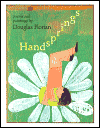
In Mud Flood, a poem in Douglas Florian’s collection HANDSPRINGS, the author talks about mud oozing on shoes and boots and pants and shirts and about the only way to get clean again—with suds. From Mud Flood

The spring rains came
And made a flood
So now there’s mud
and mud
and mud.


Lilian Moore’s Forsythia Bush is another of my favorite spring poems. In the poem Moore wrote how the forsythia…

explodes
into yellow
and
startles the street into spring.


It’s not just any poet who would think to use verbs like “explodes” and “startles” in a poem about a plant!


In Pussy Willows, Aileen Fisher speaks of rubbing Spring across the cheek of someone whose eyes are closed—Spring in this case being exemplified as “smooth as satin, soft and sleek” pussy willows.

In The Spring Wind, Charlotte Zolotow describes the spring wind as “smelling of spring and growing things/brushing the world with feathery wings.”


If you can locate a copy of Aileen Fisher’s book OUT IN THE DARK AND DAYLIGHT (Harper & Row, 1980), you will find a treasure trove of poems that focus on different signs/aspects of spring: pussy willows, mud in March, buttercups, an early bee, a robin’s song, clover, frogs, the sounds of spring, leaf buds.


Yes, share poems such as these with children and their words will implant images and rhythmic language in their minds that will serve as a poetic treasure chest for them to reach into when the time comes for them to write their own poems about spring.


Where to find the poems cited in this blog article if a book title has not been noted above:

SPRING IS by Bobbi Katz
Puddle Wonderful: Poems to Welcome Spring, selected by Bobbi Katz
The Random House Book of Poetry for Children, selected by Jack Prelutsky (page 42)
Sunflakes: Poems for Children, selected by Lilian Moore (page 54)


FORSYTHIA BUSH by Lilian Moore
I Thought I Heard the City, written by Lilian Moore
Mural on Second Avenue and Other City Poems, written by Lilian Moore

Puddle Wonderful: Poems to Welcome Spring, selected by Bobbi Katz
Something New Begins, written by Lilian Moore (page 32)


SPRING by Karla Kuskin
Dogs & Dragons, Trees & Dreams, written by Karla Kuskin (page 14)
Moon, Have You Met My Mother?: The Collected Poems of Karla Kuskin (page 112)
Puddle Wonderful: Poems to Welcome Spring, selected by Bobbi Katz
The Random House Book of Poetry for Children, selected by Jack Prelutsky (page 43)
Ring Out Wild bells: Poems about Holidays and Seasons, selected by Lee Bennett Hopkins (page 25)
The 20th Century Children’s Poetry Treasury, selected by Jack Prelutsky (page 24)

SPRING AGAIN by Karla Kuskin
Dogs & Dragons, Trees & Dreams, written by Karla Kuskin (page 14)
Moon, Have You Met My Mother?: The Collected Poems of Karla Kuskin (page 111)