Here are some booklists and web resources for Asian Pacific American Heritage Month in addition to those included in my post last Saturday.
From New York Public Library's On-Lion for Kids : Recommended books divided into the following categories: Folk and Fairy Tales, Non-Fiction, Poetry and Song, Stories for Older Readers, and Stories for Younger Readers
From the Center for Instructional Materials and Computing, School of Education at the University of Wisconsin at Madison: A “Webliography” for Asian Pacific American Heritage Month
From Scholastic’s Teacher Website: The Asian Pacific American Heritage main page includes links to author interviews with Allen Say, Ken Mochizuki, Greg Tang, and Ed Young, and to a related booklist.
An Annotated Bibliography of Books about South Asia and The South Asia Diaspora from Pooja Makhijani
Monday, May 7, 2007

Saturday, May 5, 2007
OUT & ABOUT: May 5, 2007
Kelly has the Poetry Friday roundup this week at Big A, little a.
Kelly has also compiled a terrific list of Early Readers with recommendations from a multitude of kidlit bloggers. Thanks for putting all these titles together for us in pdf format, Kelly. It’s a great resource!
Elizabeth Bird, better known to us bloggers as the Fab Fuse, wrote an article that appears in the May/June issue of The Horn Book Magazine. The article, Blogging the Kidlitospehere, can also be read here at the Horn Book website.
Jules and Eisha have an interview with fellow Blue Rose Girl Linda Wingerter—artist, skater, puppeteer, and fire spinner—at 7-Imp.
I challenged Michele of Scholar’s Blog to write an ode in praise of Doctor Who. Nearly made her ill, I did. She threatened to expel vocal vibrations at an extremely high decibel level. But she did write a prose ode for us in her Why I Love “Doctor Who” post. You may want to check it out.
At Cynsations, Cynthia Leitich Smith has a CEO Interview with Tracy Grand about JacketFlap.com.
Kelly has also compiled a terrific list of Early Readers with recommendations from a multitude of kidlit bloggers. Thanks for putting all these titles together for us in pdf format, Kelly. It’s a great resource!
Elizabeth Bird, better known to us bloggers as the Fab Fuse, wrote an article that appears in the May/June issue of The Horn Book Magazine. The article, Blogging the Kidlitospehere, can also be read here at the Horn Book website.
Jules and Eisha have an interview with fellow Blue Rose Girl Linda Wingerter—artist, skater, puppeteer, and fire spinner—at 7-Imp.
I challenged Michele of Scholar’s Blog to write an ode in praise of Doctor Who. Nearly made her ill, I did. She threatened to expel vocal vibrations at an extremely high decibel level. But she did write a prose ode for us in her Why I Love “Doctor Who” post. You may want to check it out.
At Cynsations, Cynthia Leitich Smith has a CEO Interview with Tracy Grand about JacketFlap.com.
Asian Pacific American Heritage Month
As I was reading Grace Lin’s post Happy Asian-Pacific Heritage Month at Blue Rose Girls the other day, I thought it might be a good idea to provide links to some of Grace’s other articles that are available at her author website.
Why Couldn’t Snow White Be Chinese: Finding Identity Through Children’s Books
Don’t Judge a Book by Its Character (even if it is Chinese): Why I Wrote “The Year of the Dog”
The Extra Adjective: How I Came to Terms with Being a Multicultural Author
At the Website of the National Education Association
In honor of Asian Pacific American Heritage Month NEA's Read Across America has made available a bilingual reading list of books for students in kindergarten through 12th grade. The NEA's Asian American Booklist includes fiction, nonfiction, and poetry titles divided by grade level categories: Grades K-4, Grades, 5-8, and Grades 9 and Up.
Grace Visits My Children’s Literature Class

Why Couldn’t Snow White Be Chinese: Finding Identity Through Children’s Books
Don’t Judge a Book by Its Character (even if it is Chinese): Why I Wrote “The Year of the Dog”
The Extra Adjective: How I Came to Terms with Being a Multicultural Author
At the Website of the National Education Association
In honor of Asian Pacific American Heritage Month NEA's Read Across America has made available a bilingual reading list of books for students in kindergarten through 12th grade. The NEA's Asian American Booklist includes fiction, nonfiction, and poetry titles divided by grade level categories: Grades K-4, Grades, 5-8, and Grades 9 and Up.
Grace Visits My Children’s Literature Class
Grace Signing Books
On Thursday, Grace did an audio-visual presentation of how she came to be a children’s book author and illustrator for the students in my children's literature course. We also had a fine question answer session about THE YEAR OF THE DOG, Grace's first novel.
Grace Being Silly!
Friday, May 4, 2007
POETRY FRIDAY: Spring Is...
SPRING IS
Spring is when
the morning sputters like
bacon…
spring is when
your scrambled eggs
jump
off
the
plate
and turn into a million daffodils
trembling in the sunshine.
The Language of Poetry
Those excerpts are taken from Bobbi Katz’s Spring Is, one of my favorite poems about this season. Doesn’t Katz capture the excitement a child might feel when spring has finally arrived in all its glory and the world is warm again, and alive, and waiting to be unwrapped like a long-awaited gift?
Katz follows the lead set by Spring Is with her poems in ONCE AROUND THE SUN. For this book, she wrote twelve poems. She lists the signs she associates with each month. She begins all the poems in the same fashion as Spring Is. Here are the opening lines of her poem about April:
Spring is when
the morning sputters like
bacon…
spring is when
your scrambled eggs
jump
off
the
plate
and turn into a million daffodils
trembling in the sunshine.
The Language of Poetry
Those excerpts are taken from Bobbi Katz’s Spring Is, one of my favorite poems about this season. Doesn’t Katz capture the excitement a child might feel when spring has finally arrived in all its glory and the world is warm again, and alive, and waiting to be unwrapped like a long-awaited gift?
Katz follows the lead set by Spring Is with her poems in ONCE AROUND THE SUN. For this book, she wrote twelve poems. She lists the signs she associates with each month. She begins all the poems in the same fashion as Spring Is. Here are the opening lines of her poem about April:
 April is
when the earth
parades in a green so brand-new
you can almost hear it playing a tune,
turning tight buds
of forsythia bushes
into tiny yellow trumpets…
And here is how she begins her poem about May:
May is
when the sky unties
a secret song bag
early every morning,
and the birds fly out…
I love these images Katz fashions with words. They are fresh. They certainly aren’t trite or clichéd.
Signs of Spring
I was an elementary teacher for many years. I still remember the ubiquitous “spring is” writing exercises we teachers often had children do in class to celebrate the arrival of spring. Often the children’s poems came out something like this:
Spring is flowers
and birds singing.
Spring is green grass
and warm weather.
Spring is when
I fly my kite.
Speaking from my experience as a classroom teacher, I can tell you that once I began sharing all kinds of poetry with my students, many of them began writing poetry with more inventive images like those found in the poems written by Bobbi Katz and with more of the elements of language characteristic of poetry. I think it’s equally important to give children ample time to carefully observe the world around them in mid-spring--to give them opportunities to really look at, study, and think about the changes in nature. They will then be more likely to write poems with more depth, poems that express their personal thoughts and feelings.
Let’s look at excerpts from some other excellent poems about spring that would be great to share with children.
The poems in John Updike’s A CHILD’S CALENDAR are filled with examples of particular sights, sounds, and smells that he associates with each month of the year. Here are two examples of similes he uses to describe two signs of spring from his poem about March.

From March
The sun is nervous
As a kite
That can’t quite keep
Its own string tight…
Pale crocuses
Poke through the ground
Like noses come
To sniff around.
Imagine comparing the spring sun to a nervous kite and crocuses to noses sniffing around.
In PIECES: A YEAR IN POEMS & QUILTS, Anna Grossnickle Hines writes poetry about all four seasons. Here are excerpts from Do You Know Green?, which is one of her poems about spring.
Green comes…
tickling the tips
of twiggy tree fingers…
poking up as tiny
slips of baby grass…
bursting out on bare
brown branches…
Look at how Hines uses personification here. In her poem, green is poking and bursting and tickling twiggy tree fingers.
One of the jobs of a poet is to be precise with language, to select just the right words to express thoughts and feelings, and to help readers picture the poet’s written images in their minds. Pointing out to students poets’ similes, metaphors, imagery, use of personification and alliteration, and selected use of words helps them to better understand the elements of language often found in poetry and helps expand their writing vocabulary and knowledge of the genre.
(I found making transparencies of poems and showing them to students on an overhead projector was a fine way to lead my students into a brief discussion of the poems.)
In A CIRCLE OF SEASONS, Myra Cohn Livingston makes wonderful use of personification to bring spring and all its wonders alive.

From A CIRCLE OF SEASONS:
Spring skips lightly on a thin crust of snow,
Pokes her fragrant fingers in the ground far below,
Searches for the sleeping seeds hiding in cracked earth,
Sticks a straw of sunshine down and whispers words to grow:
O seed
And root
Send forth a tiny shoot!
Capturing a Feeling
Some children may prefer to write about their personal feelings about spring—as Katz did in Spring Is— rather than make a list of things that come to mind when asked to write about the season.
In her poem entitled Spring, Karla Kuskin expresses the excitement a child feels when spring has arrived. Kuskin speaks in the voice of an exuberant youngster.
Her poem begins:
I’m shouting
I’m singing
I’m swinging through trees
I’m winging sky-high
With the buzzing black bees…
The poem ends…
I’m a bud
I’m a bloom
I’m a dove on the wing.
I’m running on rooftops
And welcoming spring.
And in Kuskin’s poem Spring Again, a child anticipates all the things she/he will do during this season of rebirth.
From Spring Again:
Buds on the branches
a breeze in the blue
and me without mittens
my sweater unbuttoned
a spring full of things
all before me to do.
Focusing on One Sign/Aspect of Spring
In Mud Flood, a poem in Douglas Florian’s collection HANDSPRINGS, the author talks about mud oozing on shoes and boots and pants and shirts and about the only way to get clean again—with suds. 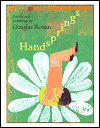 From Mud Flood
The spring rains came
And made a flood
So now there’s mud
and mud
and mud.
Lilian Moore’s Forsythia Bush is another of my favorite spring poems. In the poem Moore wrote how the forsythia…
explodes
into yellow
and
startles the street into spring.
It’s not just any poet who would think to use verbs like “explodes” and “startles” in a poem about a plant!
In Pussy Willows, Aileen Fisher speaks of rubbing Spring across the cheek of someone whose eyes are closed—Spring in this case being exemplified as “smooth as satin, soft and sleek” pussy willows.
In The Spring Wind, Charlotte Zolotow describes the spring wind as “smelling of spring and growing things/brushing the world with feathery wings.”
If you can locate a copy of Aileen Fisher’s book OUT IN THE DARK AND DAYLIGHT (Harper & Row, 1980), you will find a treasure trove of poems that focus on different signs/aspects of spring: pussy willows, mud in March, buttercups, an early bee, a robin’s song, clover, frogs, the sounds of spring, leaf buds.
Yes, share poems such as these with children and their words will implant images and rhythmic language in their minds that will serve as a poetic treasure chest for them to reach into when the time comes for them to write their own poems about spring.
Where to find the poems cited in this blog article if a book title has not been noted above:
SPRING IS by Bobbi Katz
Puddle Wonderful: Poems to Welcome Spring, selected by Bobbi Katz
The Random House Book of Poetry for Children, selected by Jack Prelutsky (page 42)
Sunflakes: Poems for Children, selected by Lilian Moore (page 54)
FORSYTHIA BUSH by Lilian Moore
I Thought I Heard the City, written by Lilian Moore
Mural on Second Avenue and Other City Poems, written by Lilian Moore
Puddle Wonderful: Poems to Welcome Spring, selected by Bobbi Katz
Something New Begins, written by Lilian Moore (page 32)
SPRING by Karla Kuskin
Dogs & Dragons, Trees & Dreams, written by Karla Kuskin (page 14)
Moon, Have You Met My Mother?: The Collected Poems of Karla Kuskin (page 112)
Puddle Wonderful: Poems to Welcome Spring, selected by Bobbi Katz
The Random House Book of Poetry for Children, selected by Jack Prelutsky (page 43)
Ring Out Wild bells: Poems about Holidays and Seasons, selected by Lee Bennett Hopkins (page 25)
The 20th Century Children’s Poetry Treasury, selected by Jack Prelutsky (page 24)
SPRING AGAIN by Karla Kuskin
Dogs & Dragons, Trees & Dreams, written by Karla Kuskin (page 14)
Moon, Have You Met My Mother?: The Collected Poems of Karla Kuskin (page 111)
Thursday, May 3, 2007
Final Project, Final Class
FINAL PROJECT
I have been busy this past week grading the final projects of the students in my children's literature course. The project is one that many students enjoy working on--especially because the finished product is something they can use in their classrooms or libraries. It's a themed poetry anthology. Here are the project requirements:

I have been busy this past week grading the final projects of the students in my children's literature course. The project is one that many students enjoy working on--especially because the finished product is something they can use in their classrooms or libraries. It's a themed poetry anthology. Here are the project requirements:
Themed Poetry Anthology
Create a themed poetry anthology for children.
- The anthology must contain at least 30 poems of quality.
- It should also contain poetry that is rhymed and unrhymed.
- Try to include different types of poetry: lyrical, narrative, persona/mask, apostrophe/poems of address, haiku, cinquain, etc.
- Do not select more than 2 works by any one poet.
- You must use no fewer than 7 different poetry collections and/or anthologies as sources for your selections. (Do not select poems from Internet Web sites!)
- Include a table of contents with the titles of the poems and names of the poets.
- Include a bibliography of the poetry collections and anthologies you used as sources for your selections. (List the poems you selected from each book.)
- Give the age or grade levels of the children for whom the anthology is intended. For example: Grades K to 3, 4 to 6, 5 to 8 or Ages 4 to 8, 6 to 10, 9 to 12.
- Consider the organization/grouping of the poems you select and how the poems work together in your themed anthology.
- Make sure your themed poetry anthology is well balanced. For example, an anthology of poems about the seasons should include an equal number of poems about each season.
- Do not submit photocopied poems. (You may photocopy concrete poems.)
- Some suggestions for your themed anthologies:
o Space
o Weather
o Seasons
o Families
o Friends/Friendship
o Childhood Activities
o Holidays
o Feelings/Emotions
o Sports
o School
o Nature
o Insects, Mammals, Reptiles & Amphibians, Birds, Mice, or Farm Animals
o The Ocean/Marine Life
FINAL CLASS

Subscribe to:
Posts (Atom)
.JPG)


